

Your child hands you another test paper, and the same maths error sits there in red ink for the third month running. That repetition usually isn’t carelessness or bad luck, because a mistake that keeps returning points to something underneath it.
For most parents, the hard part is deciding whether to order more practice or stop and rebuild the foundation first. At Somali CSC, tutors read repeated errors as evidence instead of failure, which changes what the next session looks like.
This guide shows you what a recurring mistake tells a tutor. It also shows how maths tutoring builds a plan your child can follow. So, let’s get into it.
Pattern Spotting: What Repeated Student Mistakes Across Math Topics Tell Tutors About Learning Style
Tutors rarely mark a wrong answer and move on, because the type of error says more than the score does. One slip means little. But four weeks of the same slip maps out where your child’s maths learning stops.
Three signals come up most often, and each one sends the lesson somewhere different.
- Where The Error Lands: Mistakes in the last two questions of every worksheet signal tiredness rather than a missing rule. Experienced tutors shorten the working block instead of reteaching math topics your child handles well.
- Direction Of The Slip: Dropping a negative sign every time shows one rule misfiring. Scattered wrong answers suggest guessing, and that gap decides whether the next hour drills one step or rebuilds a method.
- Crossing Between Topics: Watch for one error in both algebra and geometry, since the shared arithmetic underneath is often the real cause. Weak spatial reasoning shows up the same way, in structure, graphs, and data interpretation at once.
Read together, repeated student mistakes tell a tutor how your child thinks and which learning style the next lesson should follow. The pattern sets the plan rather than the single wrong answer at the top of the page.
Why Does the Same Maths Error Keep Coming Back for Middle School Students?

Once you can spot the pattern, the next question is why it survives week after week. Extra worksheets and repeat maths classes rehearse the same faulty step. Over time, your child gets quicker at being wrong and never gets to understand concepts. Middle school is where this bites hardest, because new math topics stack on shaky ones every term.
Two questions separate useful maths tutoring from busywork, and both start with the error itself. Good math tutoring answers them before planning a single worksheet.
What a Wrong Answer Reveals About Your Child’s Math Learning and School Grades
A wrong answer shows the exact step where the method broke, which a score out of twenty can never do. Tutors work backwards through the written attempt and stop at the first line that doesn’t make sense.
Each error leaves its own fingerprint. A student who writes “3x+2x = 5x²” has merged two rules, while one who forgets a minus sign only rushed the last line. The first child needs that rule rebuilt step by step, and the second needs pacing work. School grades sag for a whole term when maths learning stalls at one unnamed step.
Math learning moves forward when tutors read the answer as a map rather than a verdict (naming the broken step out loud makes it visible). This issue appears beyond individual classrooms. According to the Nation’s Report Card, only 28% of US eighth graders scored at or above proficient in math on the 2024 national assessment. Many of them can solve equations once someone finds the single step they miss.
Careless Slip or Missing Concept? How Expert Tutors Tell the Difference in Tutoring Sessions
Expert tutors separate the two with one prompt. They hand the question straight back without comment and watch. Careless slips correct themselves in seconds, while a missing concept produces the same wrong answer again.
You have probably seen this at home, where the question your child aced on Tuesday falls apart on Friday. Online tutoring makes that comparison easier. The work stays on a shared whiteboard, so a tutor can replay the session that went well. Tutoring sessions that help with homework the same week make the difference obvious.
Honestly, the fix splits cleanly from there, and math tutoring should follow it. Slips call for slower checking habits. Missing concepts call for going back a level until your child can understand concepts instead of copying steps (sometimes two levels back).
Adjusting Tutoring Strategies When Algebra, Word Problems, Data Interpretation, and Geometry Mistakes Repeat

Each topic that keeps breaking down needs its own response, whether the problem involves sign rules, real-world applications, or something in between. Tutors change how the session runs first and add new content once the pattern settles.
The grid below shows how support shifts for three of the most common repeat errors.
| Repeated Mistake | What It Usually Means | How Tutoring Adjusts |
|---|---|---|
| Sign errors in algebra | Rule misapplied, or steps rushed | Rebuild one rule, spoken step by step |
| Wrong formula in geometry | Outlines not linked to properties | Draw and label first to grow spatial reasoning |
| Same arithmetic slip in both | Weak number sense underneath | Short daily number work beside class |
| Stalling on word problems | Reading load hides the math in real-world applications | Translate the sentence, then solve equations |
Our experienced tutors revisit this grid every few weeks, because the pattern shifts as your child improves. Matching tutoring strategies and teaching methods to the error builds problem-solving skills your child can reuse. Advanced math and data interpretation expose the same gaps later, so a repair now saves a harder one in high school and beyond.
Building a Learning Plan That Supports Steady Progress and Problem-Solving Skills
Every student learns differently, so one error can need two routes. Keep a written learning plan that records the pattern, the chosen fix, and the date it was last checked. The same plan doubles as test prep, since it names the exact steps to rehearse before an exam.
Good online tutoring should prepare students for the unit ahead, not the one behind. Personalized tutoring keeps the plan current, so test prep stops being a scramble the night before. High school students can keep the log themselves, which builds ownership fast.
Bottom line: Interactive learning beats silent repetition. Interactive sessions where your child explains each move out loud reveal the gap faster than another worksheet. Lessons focused on that gap produce steady progress, and they build confidence along the way.
Maths Tutoring and Tuition Work Best When Personalized Learning and Online Tutoring Target the Pattern
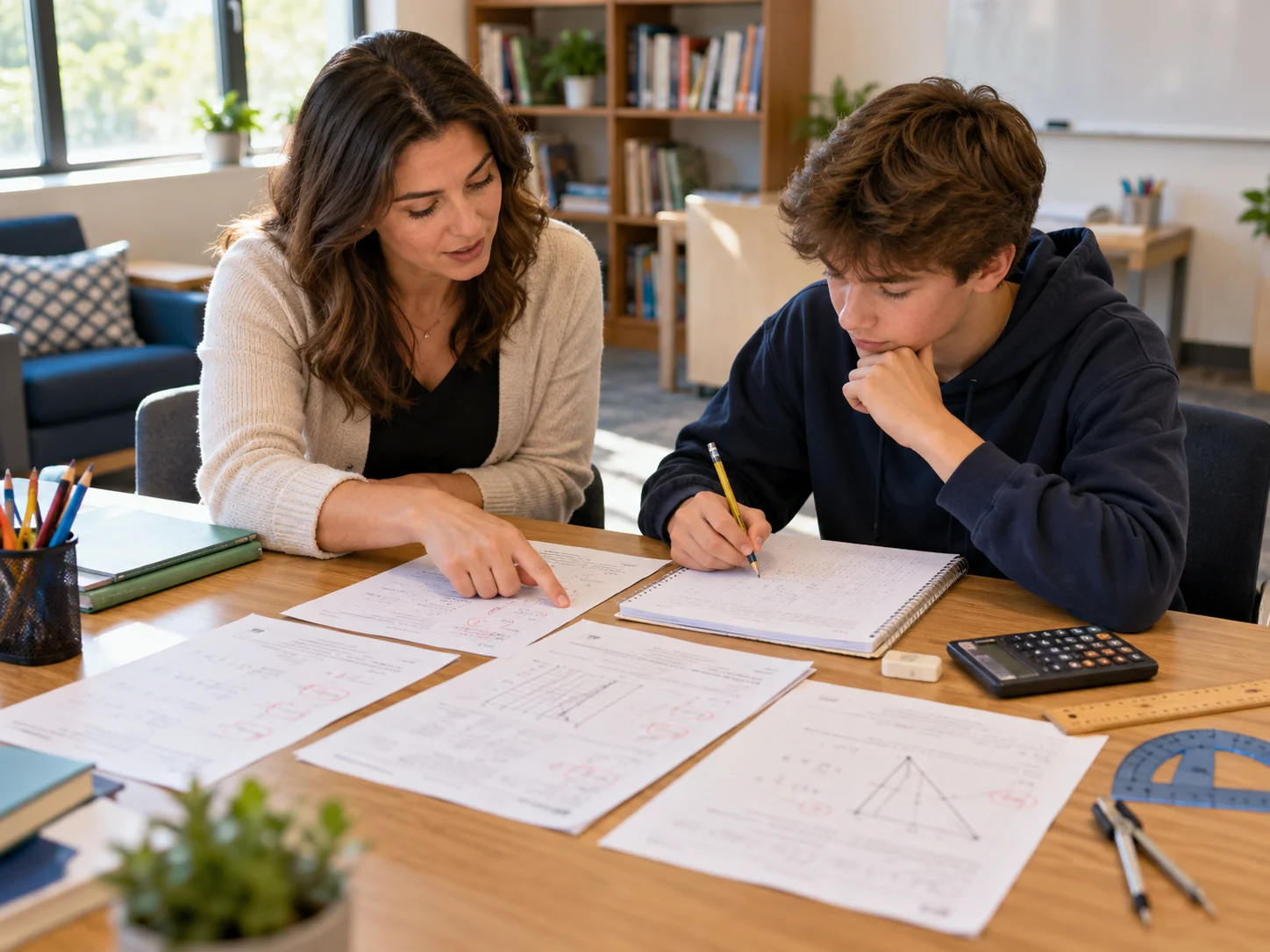
Maths tutoring works hardest when every session answers one identified pattern instead of resetting the whole syllabus. Tuition that repeats the school week returns the same result. Our tutors plan around the two or three errors that keep recurring, with lessons focused on those errors.
Because of that focus, tutoring sessions run shorter and land harder than general revision. Forty minutes aimed at one broken rule beats two hours of mixed practice, and most parents notice the shift inside a month. Online classes suit this well, since a tutor can open last week’s work on interactive whiteboards and point to the line that changed. The same hour can help with homework due that night.
The format bends around whatever your child needs that term. Some students study late in the evening after practice, while others book weekend maths classes with the same tutor each time. Personalized tutoring gives each student support based on their learning needs, helping that academic support stick over time.
We see this with students in New York and across the United States. High school students often move fastest because one repeated rule turns up in dozens of questions and steadies school grades before advanced math arrives. Teaching methods here start with the error log rather than the textbook.
Ready to Break the Cycle of Repeated Maths Mistakes With Online Maths Tutoring?
A mistake that keeps returning is the clearest instruction your child’s work can give you. Read it properly, and the next term will stop repeating the one before it.
Collect the last three papers and mark the error that shows up on all of them. Bring that pattern to a tutor who plans around it and helps your child build confidence as the error fades.
Somali CSC provides online maths tutoring, interactive classes, and academic support for students in elementary, middle, and high school and beyond. Contact us to book a free trial and see the pattern addressed head-on.